


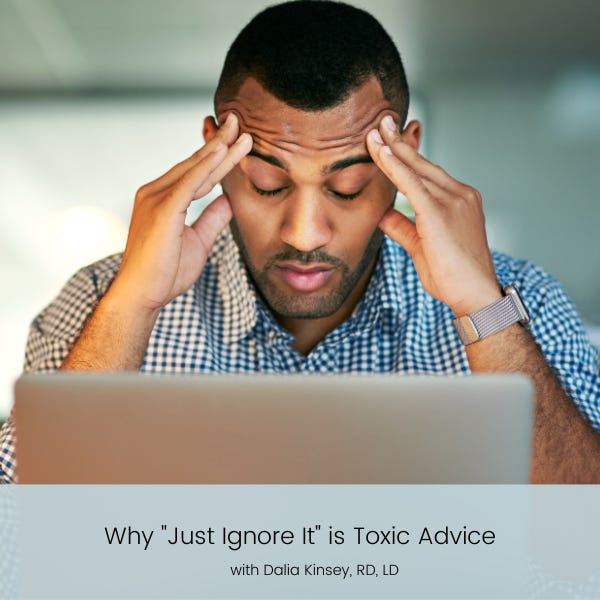
Why 'Just Ignore It' is Terrible Advice | Episode 42
Description
In the face of microaggressions and other stressors, we often encounter the well-meaning yet useless/misguided advice to "just ignore it" or "brush it off." Suppressing emotions can take a heavy toll on our mental and physical well-being. Many of us have been socialized to believe that we aren’t entitled to our emotions and that expressing vulnerability is a sign of weakness, prompting many to habitually hide their feelings. However suppressed emotions do not disappear. In this mini episode, we explore the consequences of heeding the "just ignore it" advice, revealing the importance of granting ourselves permission to feel and express emotions authentically.
This episode we discuss:
🌈Microgressions as a source of chronic toxic stress
🌈Useful ways to support folks coping with microaggressions
🌈Managing microaggressions in a self-compassionate way
🌈Validating your experience as a self-care tool
Episode Resources
Episode edited and produced by Unapologetic Amplified
This transcript was generated with the help of AI. Thank you to our supporting members for helping us improve accessibility and pay equitable wages for things like human transcription.
Have you ever wondered why almost all the health and wellness information you see out there is so white, cis able-bodied and het? I know I have. And as a queer black registered dietitian, I gotta tell you, I'm not into it. I believe health and happiness should be accessible to everyone. That is precisely why I wrote Decolonizing Wellness: A QTBIPOC-Centered Guide to Escape the Diet Trap, Heal Your Self-Image, and Achieve Body Liberation and why I host Body Liberation for All.
The road to health and happiness has a couple of extra steps for chronically stressed people, like queer folks and folks of color. But don't worry, my guests and I have got you covered. If you're ready to live the most fierce, liberated, and joyful version of your life, you are in the right place.
Body Liberation for All Theme
They might try to put you in a box, tell them that you don't accept when the world is tripping out tell them that you love yourself. Hey, Hey, smile on them. Live your life just like you like it
It’s your party negativity is not invited. For my queer folks, for my trans, people of color, let your voice be heard. Look in the mirror and say that it's time to put me first. You were born to win. Head up high with confidence. This show is for everyone. So, I thank you for tuning in. Let's go.
Have you ever tried to explain the nuances of your experience of racism, sexism, homophobia, or transphobia only to hear, well, why don't you just ignore it? You know who you are, why do you pay it any mind?
Are you the type of person who tells your LGBTQIA+ or BIPOC friends to just ignore hate, discrimination, and the subtle reminders they get about the hostile environment they're living in, in the office in the form of microaggressions.
Have you been that person? Was that your stellar advice? Just stop talking about it because, that'll probably make it better or easier for you to manage, or less uncomfortable for me to have to keep listening to. I'm going to explain why “just ignore it” is garbage advice and what we can do in lieu of stuffing down our emotions just for them to pop up in more disturbing forms later on.
So before we get into why “just ignore it” is trash advice. Let's clarify what microaggressions are. A microaggression could be defined as a statement or an action that reveals that someone has internalized bias against you. It doesn't necessarily mean that this person hates the marginalized groups that you belong to, but it does mean that they have unchecked bias, so unchecked that just.
Spills on out during the business day, during regular conversations, microaggressions, while the name makes it sound like they're not that big of a deal, the consequences for the person on the receiving end of this, it is severe. If you're a person who's had that experience of having somebody say something ridiculous to you that reveals they hold one of your marginalized identities in low esteem, like for example, oh, you're so pretty for a black girl.
Oh, you're so pretty for a trans woman. Oh, you're so well spoken. Hmm. What is the underlying implication in all of those statements? Well, you are surprised because you hold this negative belief that all black fem people are unattractive, that all trans women are not attractive. That. Or that people that look like me will not enunciate or be someone you feel like you can understand.
You may think what you've done is given a compliment. What you've done is a backhanded, hurtful comment that actually does harm. Some people have experienced suicidal ideation after. Experiencing microaggression exposure. So the consequences, depending on the emotional state of the person you are speaking to, or the other people that hear it, can in fact be very severe.
The reason why this channel even exists my work exists is because the chronic stress that people experience. When they have parts of their identity not being embraced or celebrated by the world around them, that chronic stress tears the body down and microaggressions are as much a part of that as more overt obvious signs of racism or transphobia or homophobia.
So telling someone to just ignore. Whatever microaggression they've been exposed to in the office because you think it'll cause less of a ruckus or you don't want them to make a scene, you're afraid that they'll end up being victimized if they're seen as a squeaky wheel. All of that is problematic. You are asking for the silence of the person who is the recipient of the abuse, not the abuser.
That's problematic on multiple levels. Number one, how will we put an end to that behavior in your office or in your family, or wherever this has taken place? If we don't confront it and address it? If you observe this, it would be far more helpful for you to validate the. Experience of the person who has been harmed and to ask how you could be helpful.
How would this person like for you to move forward? Do they feel like a formal complaint would be the way to go? What would feel like a proactive step? What can you do to help? No one needs for you to suggest. That they just stay silent about something that was troublesome enough to them, for them to repeat it to you.
Two. Why is this advice horrific? Where do emotions go when we suppress them? Do they just disappear? Do they never trouble us again? Absolutely not. Suppress emotions. Emotions that aren't. Experienced will get stuck in your body and pop up someplace else. When you bottle up emotions, all you're doing is delaying the experience of them, and fair enough, some people will bottle, bottle, bottle and refuse to ever directly confront emotions for their entire lifetime.
You will experience that bottled up stress, that bottled up anxiety in other ways. Sometimes it manifests as physical pain, as chronic tension that also contributes to physical pain, maybe high blood pressure, headaches, a suppressed immune system. You cannot ignore an emotion and. Expect it to dissipate.
That is not how it works. The feeling of anger, the feeling of frustration, it's there to tell you something. Whatever went wrong, you are not being oversensitive. Your feelings are valid. You are having a reaction because what you witnessed, Triggered that reaction. Now, if the people that are currently in your space can't validate your experience, that's okay.
It still needs to be validated and it still needs to be experienced. So maybe that's gonna be something you do. After work, if you are trapped in a space where it isn't safe to express frustration or anger, and if you are a person of color, you've probably had that experience of knowing that there was no way that you could phrase.
Your experience that would be acceptable to the people around you because they're just so comfortable with encouraging marginalized people to suppress their emotions and to never say anything that could possibly inconvenience. Or even slightly stress out the people with more power in the room. If you can sense, it's not a safe space for you to really be honest about what you're experiencing, that's okay.
You could journal at your desk. That's a way to process. You can call a friend on your lunch break. You can take it to the group chat, take it to someone who not only is not going to ask you for receipts or proof that what you heard is a microaggression was indeed inappropriate, but people who maybe have some similar lived experience who understand what that feels like to be stifled, to be silenced when you've been harmed in an environment that probably contributes to your chronic stress.
All the time. If that negative experience is really sticking with you, it could be something to bring up in therapy. There are also physical things that you can do to help you feel your feelings and move through them, especially with more intense feelings like anger. For me, I find deep breathing exercise or physical activity to be really helpful.
Sometimes just going for a walk is going to be enough because you can really relax. Your nervous system and breathe deeply while you're doing that, and sometimes you'll be able to fee















 United States
